Rajiv Bhuttan · CC BY 2.0
Joining the Bharat Army
India's travelling cricket fan group has 160,000 members and has been doing this since 1999 — here is how to find them
In June 1999, a 23-year-old named Rakesh Patel arrived at Old Trafford in Manchester for the India-Pakistan World Cup Super Six match and found the ground almost entirely green. Pakistani supporters had turned out in force. Indian fans were scattered, unorganised, and outnumbered.
Patel gathered roughly 200 Indian supporters into one section. They made enough noise to be heard. India won. And on the way out, someone decided they should do it again.
That is how the Bharat Army started. Not as a corporate initiative or a board-sanctioned fan club, but as a group of people who thought that supporting India abroad should feel like something.
Twenty-five years later the organisation has over 160,000 registered members across 23 countries. The BCCI invited them to meet the Indian team at their Sydney hotel after the 2018-19 series win in Australia — the squad came down, the dhols were played, and the captain danced with the fans in the hotel lobby. It was the kind of moment that tends not to happen with formally constituted supporter groups.
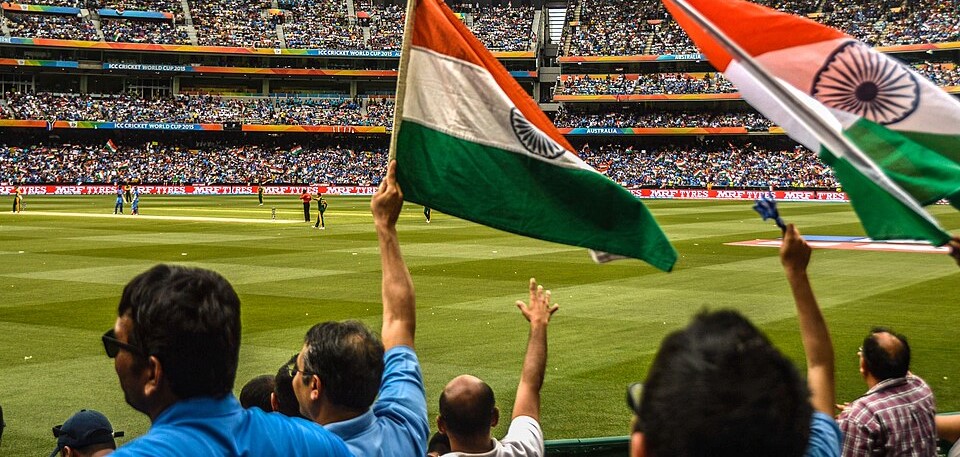
What the Bharat Army actually does at matches is straightforward: they find each other in the stands, they set up the dhol drums and the trumpets, and they generate a coordinated, sustained noise that distinguishes itself from everything else in the ground. The chants are a mix of the nationalistic (Vande Mataram, Jai Hind, Bharat Mata ki Jai) and the specific — individual songs written for individual players, some of them quite good. Rakesh Patel has said that English crowds sing more songs than anywhere else because football culture here has shaped how fans understand the role of the stands.
For the England tour in July 2026, the Bharat Army will be at every fixture. The Edgbaston ODI on 14 July is their showpiece — Birmingham's demographics make it the match where they are least alone, the ground that most resembles a home game. The Lord's ODI on 19 July is the series finale at the most famous cricket ground in the world. Trent Bridge, where the 3rd T20I is played on 7 July, is historically significant: Old Trafford in Manchester is where all of this began, and the North of England has always been where the founding energy lives.
Membership is free at the basic level. You sign up at bharatarmy.com, you get notifications about which section they're occupying at each ground, and you get access to the WhatsApp groups and social channels where pre-match meetups are organised. For those who want to go further, paid Gold membership includes travel packages, merchandise, and priority notification on ticket availability.
The meetups are worth knowing about. Patel's original instinct was that Indian fans abroad should not experience matches alone, scattered through the stands without finding each other. The pre-match gatherings are the practical expression of that. They happen at pubs and restaurants near the ground before each fixture, announced on social media a few days out. Show up and you will find people who have flown from Dubai, driven from Leeds, or taken the train from Birmingham, all of whom have been tracking this tour for months.
This is what 200 people in a stand in 1999 became.
Why it's special
Supporting a team on their home turf is one kind of experience. Following them to the other side of the world is another, and it used to be a lonelier one.
Before organisations like the Bharat Army existed, Indian fans abroad were largely invisible to each other — seated in different parts of the ground, without coordination, often the only person around them in an India shirt. The atmosphere they generated was individual and dispersed. The Barmy Army had their brass band and their section and their repertoire; Indian fans had enthusiasm and no infrastructure.
What Patel built was the infrastructure. The result, over 25 years, is that following India in England is now a collective experience with its own rituals, its own sounds, its own geography within each ground. You know which section they're in before you arrive. You know there will be dhols. You know the chants. You know there will be a meetup beforehand, and that the people at it will have come from everywhere.
I think there is something worth saying about what this represents beyond cricket. The British South Asian community — whose grandparents and parents built lives here and whose children support a team that plays away fixtures in the country they grew up in — has, through the Bharat Army, created something that acknowledges both of those things at once. It is unambiguously Indian in its character. It is also entirely at home in England. Those two facts do not need resolving.
Insider tips
- 1
Register on bharatarmy.com before the tour begins — section allocations and WhatsApp group details are distributed to registered members first, and the best spots in the stand are claimed early.
- 2
The Edgbaston ODI on 14 July is their showcase fixture — Birmingham's South Asian community means the ground atmosphere is closest to a home game; if you attend one match with the Bharat Army, make it this one.
Practical info
- Cost
- Bharat Army membership is free at basic level; Gold membership available at a fee. Match tickets separate — prices vary by ground and fixture.
- Website
- bharatarmy.com
What to avoid
Don't show up at the ground expecting to find the Bharat Army section without registering first — they don't operate a visible information desk on the day. The WhatsApp group is where meetup locations and section numbers are shared; without it you're navigating blind. Also don't underestimate the pre-match meetup — it's as much part of the experience as the match itself.