Sam Bagnall / AMA · CC BY 3.0
Edgbaston — 1st ODI
Birmingham turns blue with noise closer to a subcontinental game than anything you will find at a neutral English ground
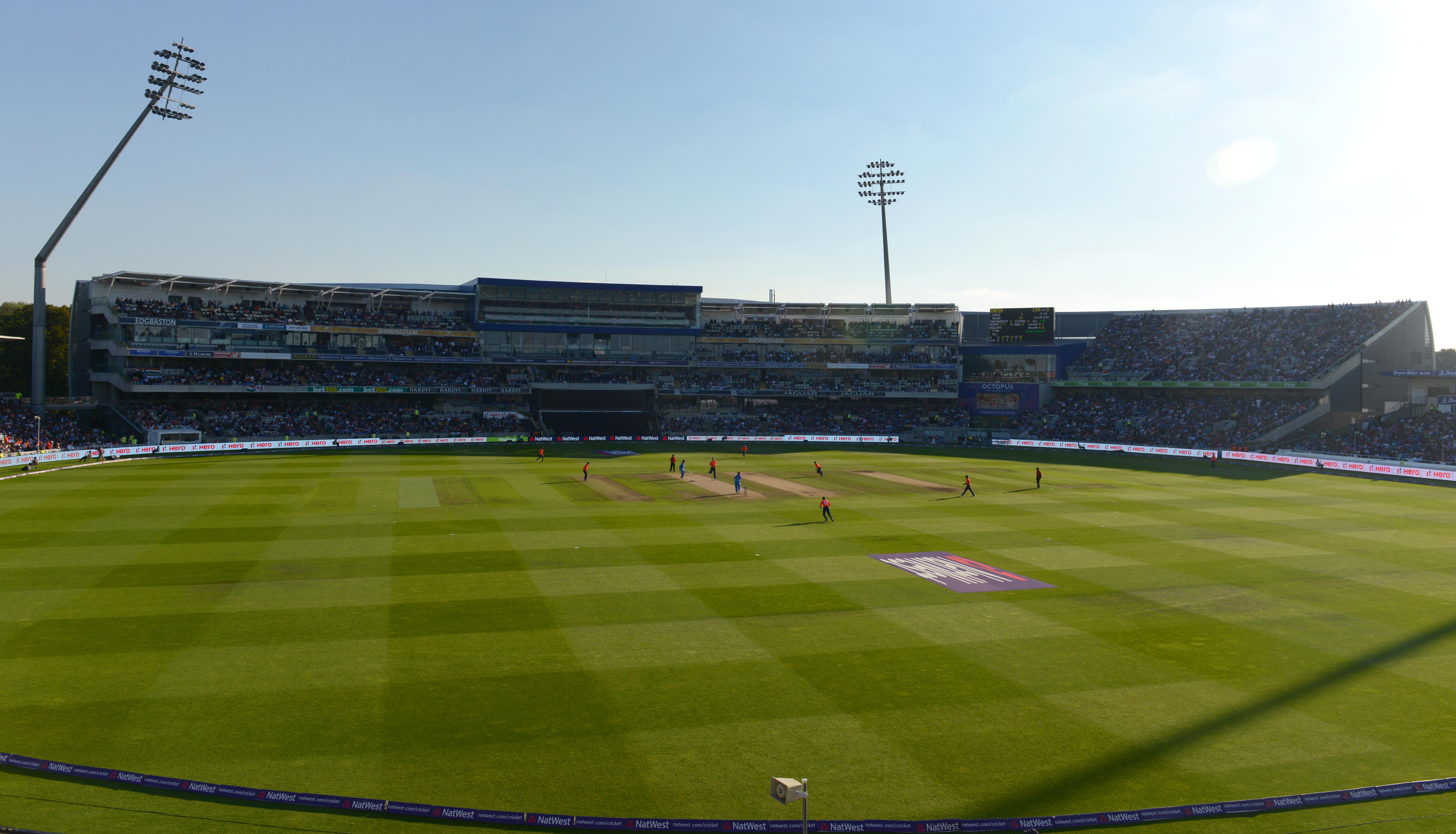
There are grounds in England where India play away fixtures. And then there is Edgbaston in July.
About 31 percent of Birmingham's population identifies as South Asian. The Indian-heritage community alone numbers close to 67,000 — the second-largest in the country outside London. Those are census figures. What they mean in practice, on a match day when India are in town, is that you walk to the ground past people in blue jerseys who have been waiting for this since the fixtures came out. Not casual fans who thought they might go. People who planned around it.
The Bharat Army have been travelling with India since 1999. They now count over 160,000 members across 23 countries, carry BCCI recognition, and travel with dhol drummers, Bollywood-tuned trumpets, tricolour flags, and enough organised noise to shift the character of any ground they're in. At most venues in England, they are a visiting presence. At Edgbaston, they are not visitors. They occupy Block 22 of the Eric Hollies Stand — the stand already considered the loudest in the ground — and they fill it with something that sounds, at full volume, less like an away end and more like a home stadium somewhere in Maharashtra.
Ben Stokes, ahead of the 2025 Edgbaston Test, described the India-England fixture there as "slight 50-50 with the support." That is the England captain conceding, straightforwardly, that his team does not fully own the crowd. No other ground in England would prompt that admission.
The 2022 Fifth Test offers the clearest picture of what this looks like at full intensity. India set England 378 to win. England chased it down in 76 overs — the match that announced the Bazball era. Even in defeat, the Bharat Army were still there on the final day, dhols going, chanting Jai Hind, singing Kal Ho Na Ho and Kuch Kuch Hota Hai with the same volume they'd brought when India were batting. The Wisden Almanack called the atmosphere that day "blissful." A packed ground, two sets of supporters, and a result that had gone the other way — and still nobody went home early.
The ODI on 14 July 2026 is a day match, starting at 11am. Gates open two hours before play. The pre-match street scene on Pershore Road — the main approach from the city centre — is part of the experience. Food stalls, jerseys, flags, groups of fans from across the country and beyond who have converged on a Tuesday in Birmingham to watch a cricket match. It does not look like a midweek county fixture. It looks like something that matters.
Getting there from Birmingham New Street is a walk of about 40 minutes if you go on foot down Edgbaston Road — a useful way to arrive already inside the atmosphere. The buses on routes 45 and 47 run from the city centre to Pershore Road, a two-minute walk from the gates. Match-day shuttle buses also run directly from New Street. A taxi takes about ten minutes.
The Eric Hollies Stand is the one to be in if you want the full version of this. Not the quieter ends. Not the corporate suites. Block 22, where you'll find the drums and the flags and the particular kind of joy that comes from watching your team play on foreign soil with 25,000 people treating it as anything but.
Why it's special
Most grounds in England have an away end. A small section, ticketed separately, where visiting fans congregate. Tolerated. Contained. Edgbaston in July is not that arrangement.
What makes this worth being at — and worth travelling for — is that the demographic reality of Birmingham has quietly transformed what an India fixture means at this ground. The city's South Asian population is not a recent arrival. It spans three generations. Second and third-generation British Indians who grew up supporting India as their team, who have been to Edgbaston before, who know which stand to buy in and where to meet before the gates open. The Bharat Army provides the organised core. The city provides the rest.
The effect, at its best, is a kind of double atmosphere. England's Barmy Army are present, they are loud, and they are good at this. But the Bharat Army in the Eric Hollies Stand are doing something different — dhols rather than brass, Bollywood rather than sea shanties, a whole different sonic texture running alongside the other. Two fan cultures, both taking it seriously, in the same bowl of a ground.
I find it hard to think of another international fixture in England where you feel this clearly that the match belongs equally to both sets of fans. At most grounds, the home crowd absorbs everything. Here, from the first hour, it is genuinely, audibly, visibly contested — and the result, whatever it turns out to be, is a better day of cricket for it.
It's possibly also the last time that one would see Kohli and Rohit playing for India in England. Extra special.
Insider tips
- 1
Book Block 22 of the Eric Hollies Stand specifically — that is where the Bharat Army drums and flags are concentrated, and the difference in atmosphere between Block 22 and the rest of the ground on an India match day is significant.
- 2
Arrive well before gates open: the pre-match scene on Pershore Road — food stalls, jerseys, fans who have travelled from across the country — is part of the day, and it builds for an hour before play starts.
Practical info
- Hours
- Gates open 2 hours before play (9am for 11am start on 14 July 2026)
- Cost
- General admission tickets from ~£30; Eric Hollies Stand tickets typically £50–80 for ODIs
- Access
- Book via edgbaston.com or ecb.co.uk — Eric Hollies Stand sells out well ahead of India fixtures.
- Getting there
- From Birmingham New Street: bus routes 45 or 47 to Pershore Road (5 minutes, 2-minute walk to gates), match-day shuttle buses direct from New Street, or a 40-minute walk down Edgbaston Road. Taxi from New Street takes approximately 10 minutes. Do not drive — parking near the ground on match days is extremely limited.
- Address
- Edgbaston Cricket Ground, Edgbaston Road, Birmingham B5 7QU
- Website
- edgbaston.com/tickets
What to avoid
Don't turn up without a ticket expecting to buy at the gate — India fixtures at Edgbaston sell out, and touts on Pershore Road charge significant premiums. And don't underestimate the walk from the city centre; the 40-minute route down Edgbaston Road is fine if you leave early, but cutting it close means arriving as play starts rather than being part of the build-up.